
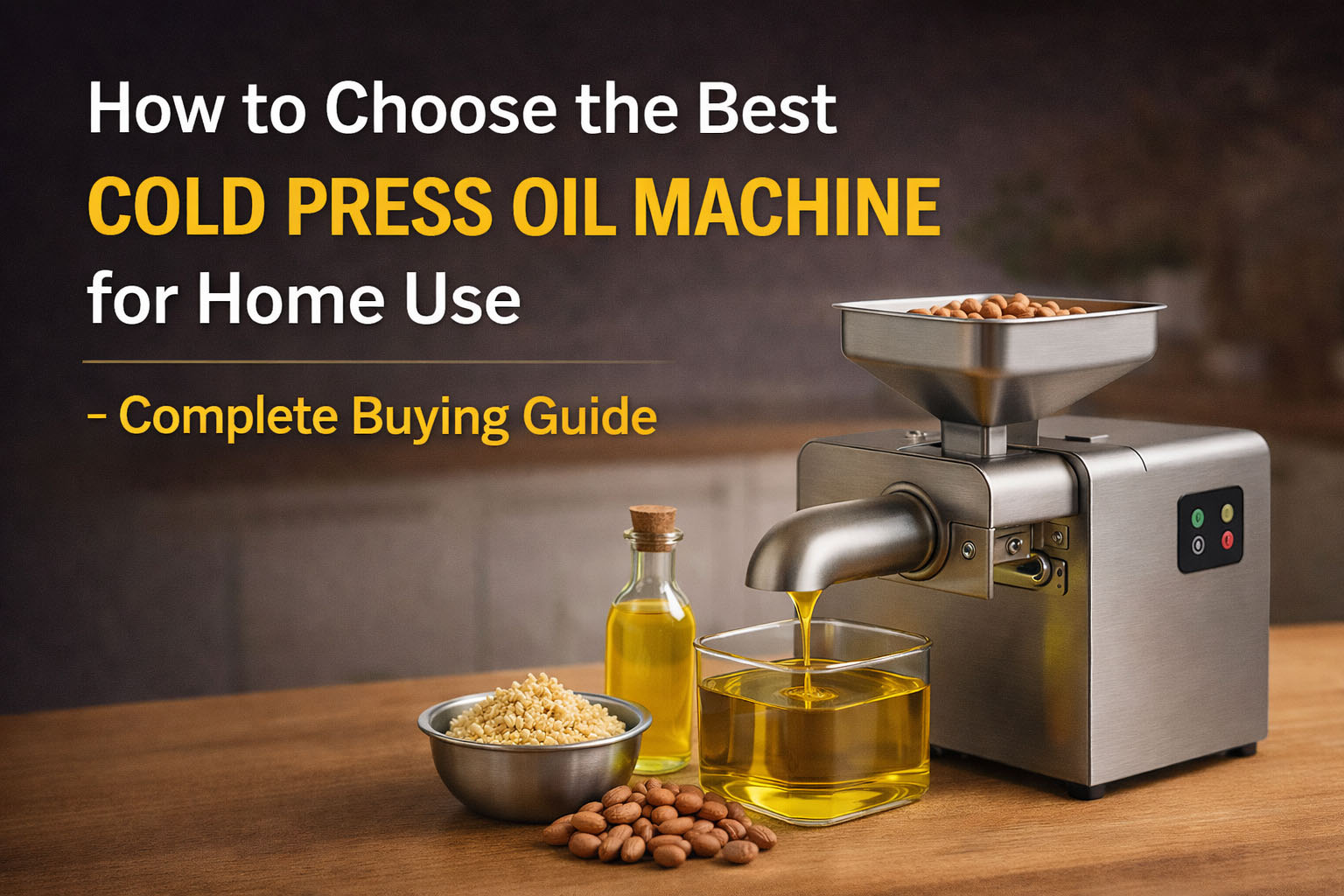
Today we are going to learn everything about how to choose the best cold press oil machine for home. In most Indian homes, oil is more than an ingredient — it’s a tradition. The sizzling sound of mustard oil in Bengali kitchens, the aroma of coconut oil in Kerala, or the earthy flavour of groundnut oil in Gujarat — each has its own heritage.
But in recent years, health awareness has grown. Families are slowly moving away from refined oils, which are chemically processed and stripped of nutrients. Instead, they’re returning to pure, cold-pressed oils — rich in flavour, antioxidants, and good fats.
And that’s where a cold press oil machine for home comes in. It allows you to make your own oil, fresh, chemical-free, and tailored to your preference — right in your kitchen.
If you’ve been browsing online and wondering, “Which cold press oil machine should I buy for my home?”, this complete guide will make it easy.
By the end, you’ll know:
- How these machines actually work
- What features matter most for Indian kitchens
- How much you should spend
- Which brands are worth your money
- And how to maintain your machine for years of reliable use
Let’s begin your journey to healthier, homemade oil.
Here’s a complete guide about cold press oil machines.
Note: This guide is based on real user feedback, Indian seed yield tests, and machine specifications from verified sellers
🌿 Understanding How a Cold Press Oil Machine Works
A cold press oil machine extracts oil from seeds using slow mechanical pressure without heat or chemicals, preserving nutrients and natural aroma.
Inside the machine, there’s a rotating screw (called a worm) that crushes seeds. As pressure builds, oil separates from the seed pulp and flows through small holes into a collector. The leftover seed cake exits separately.
Because there’s no high heat, the oil retains natural colour, flavour, and nutrition.
Here’s why that matters:
| Refined Oil | Cold-Pressed Oil |
| Heated to 200°C | Pressed below 45°C |
| Chemicals used for extraction | No chemicals, just pressure |
| Long shelf life, fewer nutrients | Shorter shelf life, higher nutrition |
| Tasteless and neutral | Rich aroma and flavour |
For Indian households that prefer natural, preservative-free food, cold pressing is the best alternative. You get oil that’s as pure as what your grandparents once made in traditional ghani machines — but in a compact, modern form.
Key Factors to Consider Before Buying a Cold Press Oil Machine
Buying a cold press oil machine is like choosing a long-term kitchen partner. The right one makes oil-making effortless. The wrong one can turn it into a chore.
Here’s a detailed look at what to check before placing your order.
1️⃣ Capacity and Family Size
Capacity is the first thing to consider.
For most urban families of 3–4 members, a 3–4 kg/hour capacity is perfect. This means you can get about 1 litre of oil per hour, depending on the seed type.
If you have a joint family or plan to sell small batches to neighbours, consider 6–8 kg/hour models.
However, remember: cold pressing is slow by design. The machine focuses on quality, not speed. Buying a bigger machine doesn’t always mean faster oil — it simply consumes more electricity and takes up more space.
So, pick based on your oil needs, not size envy.
Example: For a family of 4 consuming 3 litres of oil a month, you’ll need to press seeds twice a week — around 1.5 kg per session. A mid-range 500W machine can easily handle that.
2️⃣ Motor Power and Energy Efficiency
The motor is the heart of the cold press oil machine. It determines how efficiently your seeds are crushed and how long the machine can run continuously.
In India, where voltage fluctuations are common, opt for a high-quality copper motor with overheating protection.
- 400–450 W motors – great for soft seeds (sesame, sunflower).
- 600–700 W motors – ideal for hard seeds (coconut, mustard, groundnut).
A good motor ensures the screw doesn’t jam and oil flow remains steady.
Also, check for energy efficiency. Most modern Indian models consume around 0.4–0.6 units of electricity per hour — roughly ₹3–₹5 per batch.
⚡ Tip: Look for inverter-compatible machines if you live in areas with frequent power cuts.
3️⃣ Material Quality
Durability and hygiene go hand-in-hand here.
Always prefer food-grade stainless steel (SS 304) for the screw, chamber, and hopper. It doesn’t rust, react with oil, or absorb flavours.
Avoid machines that use aluminium or plastic for critical parts — they degrade faster and may contaminate your oil.
Brands like Savaliya and EPS use thick, polished stainless steel barrels that last for years and clean easily.
🧩 Tip: If you live near the coast (high humidity), stainless steel is non-negotiable — it prevents corrosion and extends lifespan.
4️⃣ Ease of Operation and Cleaning
A good machine should feel like a modern appliance, not an engineering project.
Look for:
- One-touch start buttons
- Detachable components for washing
- Automatic shut-off once pressing is done
- Self-cleaning function (some models have this now)
In Indian homes, where multiple family members may use it, ease of use is crucial. Machines from Agaro and Gorek are popular because they work straight out of the box — no complicated setup.
Example: EPS 01HD comes with a cleaning brush and a separate waste tray, so you can finish cleaning in under 10 minutes.
5️⃣ Noise Level and Heat Protection
You don’t want your kitchen to sound like a workshop.
Choose a machine that operates below 60 dB — that’s quieter than a mixer grinder.
Also, ensure it has overheat protection and ventilation fans. These features prevent the oil from heating up and preserve its cold-pressed quality.
🔇 Pro Tip: Machines with double-fan cooling (like Shreeja and Gorek) can run longer without getting hot, ideal for Indian summers.
6️⃣ Multi-Seed Compatibility
Indian households rarely use just one oil. Some prefer mustard oil for frying, sesame for chutneys, and coconut oil for hair or skincare.
A versatile machine that handles all seeds gives you flexibility and better value for money.
Before buying, check if the manufacturer lists support for:
- Groundnut
- Mustard
- Sesame
- Sunflower
- Flaxseed
- Coconut
- Almond
This way, you can switch seeds anytime depending on your family’s needs or seasonal preference.
7️⃣ Warranty and After-Sales Support
Even the best machines can need service. So never skip the warranty details.
A minimum one-year warranty is standard, but some premium brands offer two years on the motor.
Before you buy online, verify the brand’s service coverage. Big names like EPS, Shreeja, and Savaliya have centres across metros like Mumbai, Delhi, and Chennai.
Also, check if the brand provides pickup-and-drop repair options — convenient for smaller towns.
🧩 Tip: Take a picture of your invoice and serial number immediately after purchase. You’ll need these for warranty claims later.
Types of Cold Press Oil Machines for Home Use
You already know the three broad types: manual, semi-automatic, and fully automatic. Now let’s expand on real-world use cases and the small features that matter day to day.
🧭 Manual Machines — who they fit
Manual presses suit hobbyists and rural homes. They cost little. They need no electricity. You turn a handle or use a small lever. But you will get low yield. You will need time and effort. For someone who presses oil once a month, a manual model works.
Key points:
- Very low running cost.
- Best for 250–500 ml batches.
- No electronic parts to fail.
- Not ideal for daily cooking needs.
⚙️ Semi-Automatic Machines — a practical middle
Semi-automatic models use a motor for pressing. But you feed seeds by hand. They balance price and convenience. Many Indian families choose them because they last and cost less than full automatics.
Key points:
- Good for weekly batches.
- Easier on motors than continuous automatic use.
- Often repairable at local service centres.
- Lower purchase cost than full automatics.
⚡ Fully Automatic Machines — ease and scale
These are plug-and-play. They control temperature and pressure. They stop automatically when the job is done. You can run them for longer. They cost more, but they save time.
Key points:
- Best for daily users and joint families.
- Higher yield and consistent quality.
- Useful if you plan small-scale sales.
- More electronics; need careful handling and warranty.
📊 Feature-Based Comparison (Quick Reference)
| Feature | Manual | Semi-Auto | Automatic |
| Upfront cost | Very low | Moderate | Higher |
| Ease of use | Low | Medium | High |
| Yield consistency | Low | Medium | High |
| Electricity needed | No | Yes | Yes |
| Best for | Hobby / rural | Small families | Regular / business |
Price Ranges & What You Really Get in India
Price bands change with features. Below is a realistic snapshot for current Indian markets. I list likely features you will find at each level.
🟩 Budget (₹6,000 – ₹12,000)
What you get: compact body, 350–450 W motor, basic warranty. These machines press soft seeds well. They may struggle with dry coconut or castor seed. They suit beginners.
Use case: first-time buyers, homes with low oil needs.
🟨 Mid-Range (₹12,000 – ₹20,000)
What you get: 500–650 W motor, stainless-steel body, better cooling, removable parts for cleaning, 1–2 year warranty. These handle a wide range of Indian seeds.
Use case: regular family use, up to 3–4 litres per month.
🟦 Premium (₹20,000 – ₹35,000+)
What you get: 700 W plus motor, continuous-run design, low-noise motors, self-clean features, longer warranty, and good after-sales. These models can work for micro-business use.
Use case: joint families, sellers, and heavy users.
Note: Prices can vary by city, festival sales, or bundled accessories. Always compare final price including shipping and warranty activation.
Best Cold Press Oil Machine Brands in India
I list brands that Indian buyers frequently choose. I note strengths and common uses. This helps you map brand to need.
Savaliya Industries
Strengths: Affordable range. Good basic build quality. Strong presence in Gujarat and West India. Great for budget and mid-range buyers.
Best for: first-time buyers and small families.
EPS (Eco Smart Products)
Strengths: Sturdy motors. Digital controls on some models. Good for coconut and mustard. Decent pan-India service.
Best for: mid-range buyers who want more control.
Shreeja Health Care
Strengths: Semi-commercial models. Heavy-duty motors. Good for sellers and communities.
Best for: small businesses and cooperative groups.
Gorek Technologies
Strengths: Balanced features and durability. Popular in Maharashtra and parts of South India.
Best for: buyers who want solid, no-frills performance.
Local/Regional Makers
Many Indian towns have local workshops that make reliable machines. They often offer fast spare-part service. However, check for food-grade materials and real warranty. Avoid unbranded imports that lack service backup.
For side-by-side specs, see:
Best Cold Press Oil Machine for Home – Top Models Compared
Real-World Buying Examples (Practical Scenarios)
These mini-cases help you see which machine fits common Indian situations.
Case A — Young couple in Pune, cooks twice a week
They want fresh sesame oil and occasional groundnut oil. They choose a mid-range semi-auto with 500 W motor. It fits their budget and counter space.
Case B — Joint family in Lucknow, cooks daily and uses mustard oil
They need a higher capacity machine. They choose a 700 W automatic. It handles mustard and groundnut with ease. They save money long term.
Case C — Homemaker in Kochi, wants coconut oil plus hair-care use
She prefers a mid-range automatic that can press copra or dried coconut. She buys from a local dealer to try a demo.
⚠️ Common Buying Mistakes — Avoid These
Many buyers regret these choices. Learn from them.
1. Buying based on price alone
A cheap machine can cost more in repairs. Look at motor grade and part material.
2. Ignoring local service network
If a motor fails, you need prompt service. Check for service centres nearby.
3. Not checking seed compatibility
Some cheap models list “all seeds,” but perform poorly on hard seeds. Verify with the brand.
4. Assuming higher wattage equals better yield
Wattage matters, but so does screw design and build quality. Read reviews and real tests.
5. Skipping return policy and invoice copy
Keep all papers and register the product. Otherwise you forfeit warranty claims.
Checklist Before Hitting Buy
- Confirm seller authenticity.
- Check model-specific seed list.
- Read 10+ verified reviews.
- Verify warranty terms and service location.
- Measure countertop space.
- Ask about replacement parts cost.
Must-Have Accessories and Setup Essentials
Buying the machine is only the first step. The right accessories make daily use easier and ensure the oil stays pure and long-lasting. Here’s a detailed breakdown for Indian households.
1. Fine-Mesh Oil Filter or Strainer
After pressing, the oil contains tiny seed particles. A stainless-steel mesh filter removes them. Choose a fine mesh (300-micron or smaller). If you use a cloth, pick unbleached muslin. Avoid nylon — it can hold odour.
2. Food-Grade Storage Bottles
Use dark glass or steel bottles. Sunlight reduces freshness. Avoid recycled plastic or PET bottles for long-term use.
For Indian kitchens, 500 ml and 1-litre bottles are convenient. Many buyers now use swing-top bottles or flip caps for easy pouring.
Pro tip: Label bottles by date and seed type. Groundnut, sesame, and mustard have different shelf lives.
3. Cleaning Brushes and Tools
Every machine comes with one, but keep a spare. Small screw brushes remove stuck residue. If residue hardens, soak parts in warm water for 5 minutes (motor excluded).
In humid Indian climates, always dry parts completely before storing.
4. Measuring Scoops and Seed Trays
A measuring scoop ensures consistent feed. For home use, 300–500 grams per batch works best.
A tray or funnel keeps seeds from spilling, saving both time and cleanup.
5. Voltage Stabiliser
Optional but smart. Indian power fluctuations can damage motors. A ₹800–₹1,000 stabiliser prevents overheating and voided warranties.
Buying Online vs Offline – A Real Indian Perspective
In 2025, around 70% of cold press oil machines in India are bought online. Yet offline still has loyal buyers. Let’s compare both options in detail.
🛒 Online Buying
Advantages:
- You get the best deals during sales like Amazon Great Indian Festival or Flipkart Big Billion Days.
- You can compare multiple brands in minutes.
- Real customer reviews help identify genuine issues.
- Free shipping and quick returns on damaged items.
Disadvantages:
- You cannot check build quality before buying.
- Some unknown sellers ship duplicate units.
Tips for safe online buying:
- Choose “Fulfilled by Amazon” or “Flipkart Assured.”
- Avoid unverified third-party listings.
- Read recent 1-star reviews to detect repeated complaints.
- Check the “In the Box” list for missing parts.
Where to Buy Cold Press Oil Machine for Home – Trusted Sites & Discounts
🏪 Offline Buying
Advantages:
- You can see, touch, and test the machine before payment.
- Store staff can show you how to assemble and clean it.
- You get instant service if the product has a problem.
Disadvantages:
- Prices are often 10–15% higher.
- Limited variety compared to online stores.
Offline buying is great if you live near big appliance stores in cities like Chennai, Pune, or Coimbatore — or near a regional manufacturer. Many dealers also give 1-litre oil-seed starter packs as bonuses.
🧾 Expanded Pre-Purchase Checklist
Here’s a ready-to-use checklist you can print before finalising your order.
| Step | What to Check | Why It Matters |
| 1 | Capacity (kg/hr) | Match family size and frequency |
| 2 | Motor Power (W) | 500+ W for coconut, mustard, groundnut |
| 3 | Material | Food-grade stainless steel lasts longer |
| 4 | Noise Level | Below 60 dB for apartment comfort |
| 5 | Seed Compatibility | Mustard, groundnut, coconut, sesame |
| 6 | Overheat Protection | Prevents burning smell and motor damage |
| 7 | Warranty | At least 1 year, ideally 2 |
| 8 | After-Sales Network | Nearby service centres or courier support |
| 9 | Verified Seller | Avoid counterfeit listings |
| 10 | Accessories Included | Filter, brush, waste tray, measuring cup |
| 11 | Electricity Usage | 0.4–0.6 units/hour on average |
| 12 | Countertop Space | 1.5–2 ft space needed |
| 13 | Return Policy | Minimum 7–10 days from delivery date |
| 14 | Service Reviews | Check feedback for response time |
| 15 | Replacement Part Cost | Ask brand for screw/barrel pricing |
Keep this handy for both online and offline purchases.
Maintenance: The Real Secret to Longevity
A well-maintained cold press oil machine can last 5–7 years without major repairs. Think of it like your gas stove — use, clean, rest, and reuse.
Daily Care (After Every Use)
- Remove the screw and barrel after each batch.
- Brush out residue and rinse with warm water.
- Dry all metal parts completely before assembly.
- Wipe the motor section with a soft dry cloth.
Weekly Care
- Run the machine empty for 30 seconds to clear oil.
- Apply a drop of edible oil on the screw joints.
- Clean cooling vents with a dry brush.
Monthly Check
- Inspect the power cable for wear.
- Tighten screws and bolts.
- Lubricate moving parts lightly (food-grade oil).
- For heavy use, replace filters once every 3 months.
🧩 Tip: Use a silica gel pouch in the storage area to prevent moisture buildup — especially during monsoon months.
We also cover this in detail in our guide:
Cleaning and Maintaining Your Cold Press Oil Machine at Home
Troubleshooting Common Problems
| Issue | Likely Cause | Simple Fix |
| Machine stops midway | Overheating or overload | Let it cool for 10 mins and restart |
| Low oil output | Damp seeds | Dry seeds under sunlight for 1 hour |
| Oil smells burnt | Overheating | Reduce batch size or rest between runs |
| Unusual vibration | Loose screw or barrel | Tighten all parts before next use |
| Cloudy oil | Unfiltered or mixed seeds | Filter again using mesh cloth |
Most issues are minor and fixable at home. Still, if your machine is under warranty, avoid opening the motor section yourself.
Real Cost and ROI for Indian Households
Let’s see what you actually save by pressing oil at home.
Example: Groundnut Oil (most common in India)
- 1 kg groundnut seeds = ₹120
- Yields 400 ml oil + 600 g seed cake
- Seed cake can be used as compost or cattle feed
So 2.5 kg seeds produce 1 litre of pure oil = ₹300 cost.
Market price of branded cold-pressed groundnut oil = ₹550–₹600/litre.
Savings: ₹250–₹300 per litre.
Now assume your family uses 4 litres/month → ₹1,000+ saved monthly.
Machine cost = ₹15,000 → Payback in ~15 months.
After that, it’s pure profit (and pure oil).
Example: Coconut Oil (South India)
- 1 kg dried copra = ₹200 → ~300 ml oil yield
- 3.5 kg = ₹700 for 1 litre
- Market price = ₹900–₹950/litre
- Savings: ₹250/litre + no preservatives
Example: Mustard Oil (North & East India)
- 1 kg mustard = ₹100 → ~350 ml oil
- 3 kg = ₹300 → 1 litre oil
- Market price = ₹500–₹550
- Savings: ₹200–₹250/litre
If you buy seeds in bulk directly from local mills or farmers, savings increase by another 10–15%.
You can read the full breakdown here:
Is Cold Pressed Oil Worth It? Cost vs Health Benefits
Environmental & Community Benefits of Home Oil Pressing
Home oil pressing is not only about personal health — it’s also about impact.
- Less Plastic Waste: You reuse bottles instead of buying new ones each month.
- Support Local Farmers: Buying seeds from local markets encourages sustainable agriculture.
- Lower Carbon Footprint: Reduced transport of bottled oils means less emissions.
- Cleaner Kitchen Habits: You use pure oils without industrial residue.
Many Indian households now form small community groups to share machines and buy seeds in bulk. It builds trust, reduces cost, and supports local markets.
Advanced Maintenance & Long-Term Care
Once you’ve used your machine for a few months, regular care keeps performance high and prevents early wear.
Quarterly Deep-Clean
Every three months, disassemble the main barrel, screw, and seed hopper. Soak the parts in warm water with a drop of mild dish soap for five minutes. Scrub gently using the supplied brush. Dry completely before reassembly. Never soak or wash the motor housing.
Seasonal Storage
If you travel or stop using the machine for a few weeks, coat the screw with a few drops of edible oil and store it in an airtight bag. Keep the entire unit covered to avoid dust. During monsoon, use a small silica-gel packet inside the storage cupboard.
Annual Service
Even if everything runs smoothly, have the motor checked once a year. Most Indian brands offer courier pick-up. Preventive maintenance costs around ₹300–₹600 and extends life by several years.
Tip – Treat your cold press like any major kitchen appliance: light oiling, gentle cleaning, and proper rest make it last longer.
🌾 Regional Oil Preferences in India
Knowing which oils suit which region helps you pick the right seeds for regular use — and thus the right machine capacity.
| Region | Popular Oil Type | Typical Seed | Aroma & Use |
| North India | Mustard | Rai / Sarson | Pungent, perfect for frying & pickles |
| West India | Groundnut | Moongphali | Nutty flavour, stable at high heat |
| South India | Coconut & Sesame | Copra / Til | Mild, used for chutneys & idlis |
| East India | Mustard & Sunflower | Sarson / Surajmukhi | Sharp yet light texture |
| Central India | Sunflower & Soybean | — | Neutral taste for mixed dishes |
If your family cooks multiple cuisines, a multi-seed compatible automatic model is best.
Extended FAQ — Real Questions from Indian Buyers
Q1. Is cold-pressed oil safe for frying?
Yes. Groundnut, mustard, and sunflower cold-pressed oils handle typical Indian frying temperatures well.
Q2. Can I use fresh coconuts instead of dried copra?
Use dried copra pieces only. Fresh coconut adds water and reduces oil yield.
Q3. How long does fresh oil last?
Most stay fresh 3–6 months if stored in dark bottles away from heat. Coconut oil lasts up to a year.
Q4. Why is my oil cloudy after pressing?
Tiny particles remain suspended. Filter through a fine mesh and rest the oil for 24 hours — it clears naturally.
Q5. How noisy are these machines?
Below 60 dB, quieter than a mixer grinder. Perfect for apartments.
Q6. Can I press castor or neem oil at home?
Technically yes, but avoid for edible use. They’re medicinal and need special handling.
Q7. What should I do with leftover seed cake?
Dry it and use as fertilizer for kitchen gardens or give to local dairy farmers as feed.
Comparing After-Sales Support (Indian Brands)
| Brand | Avg. Warranty | Service Network | Unique Support Feature |
| Savaliya | 1 year | West & North India | Easy WhatsApp support |
| EPS | 1–2 years | Pan-India | Free courier pick-up in metros |
| Agaro | 1 year | Major cities | Dedicated helpline + video support |
| Shreeja | 2 years | South & Metro | Semi-commercial service options |
| Gorek | 1 year | Pan-India | Quick spare-part shipping |
Check brand websites before buying; many now offer online service registration in under 5 minutes.
Practical ROI Example — Detailed Calculation
Let’s take a family in Pune using 4 litres of oil per month.
- Machine cost = ₹16 000
- Seeds bought in bulk cost ≈ ₹120/kg (groundnut)
- 1 kg yields ≈ 400 ml → ₹300/litre homemade cost
- Market price = ₹560/litre
- Savings = ₹260/litre × 4 = ₹1 040/month
Break-even = ₹16 000 ÷ ₹1 040 ≈ 15 months.
After that, every litre is pure saving. Over five years, the family saves ₹60 000+ — enough to replace the machine twice over.
Quick Comparison: Cold Press vs Buying Store Oil
| Aspect | Homemade Cold Press Oil | Branded Cold Pressed Bottle |
| Cost | ₹300 – ₹350/litre | ₹550 – ₹650/litre |
| Freshness | Made on demand | Weeks old |
| Additives | None | May use antioxidants |
| Storage | Reusable bottle | Plastic packaging |
| Custom Choice | Any seed | Limited variety |
| Shelf Life | 3–6 months | 6–9 months |
Even when you factor in electricity and cleaning time, homemade oil wins on purity and cost.
Expert Buyer Tips for Indian Homes
- Start small, scale up. Press 1 kg seeds first to understand yield and taste.
- Rotate seeds. Groundnut in winter, sunflower in summer — variety helps health.
- Buy seeds in bulk locally. Mandis or farmers’ markets offer fresher stock.
- Keep spare parts. Order an extra filter and brush along with the machine.
- Avoid non-branded imports. Cheap models often have no service support.
- Educate family. Once everyone knows the simple steps, usage becomes regular.
- Record batches. Note seed quantity and oil output to track efficiency.
- Sell extra oil within society. Neighbours often buy fresh cold-pressed oil happily.
- Join Facebook/WhatsApp groups. Communities share tricks and seed sources.
- Use renewable power. If you have solar panels, press oil for free electricity!
Future Trends in Cold Press Machines
- Smart oil presses: Upcoming models will have app control and auto temperature adjustment.
- Integrated grinders: Dual-purpose machines to grind flour or spices.
- Rural co-ops: Farm clusters buying machines for collective use.
- Eco packaging: Steel oil containers replacing plastic pouches in urban stores.
Being early in this trend positions you as a “home oil expert” — something more and more Indians are embracing.
Conclusion — Your Path to Pure Oil
Choosing the best cold press oil machine for home isn’t just a purchase; it’s a lifestyle upgrade. You control what enters your body. You reconnect with traditional Indian food values. And you save money every month.
Remember the three pillars of a smart buy:
- Pick the right capacity and motor for your family size.
- Choose trusted brands with solid service networks.
- Maintain the machine regularly for consistent results.
Once you experience the aroma of fresh mustard or groundnut oil from your own kitchen, you’ll never return to store-bought bottles.
Cold Press Oil Machine for Home – The Complete Beginner’s Guide
Best Cold Press Oil Machine for Home – Top 4 Models Compared





0 Comments