
Introduction
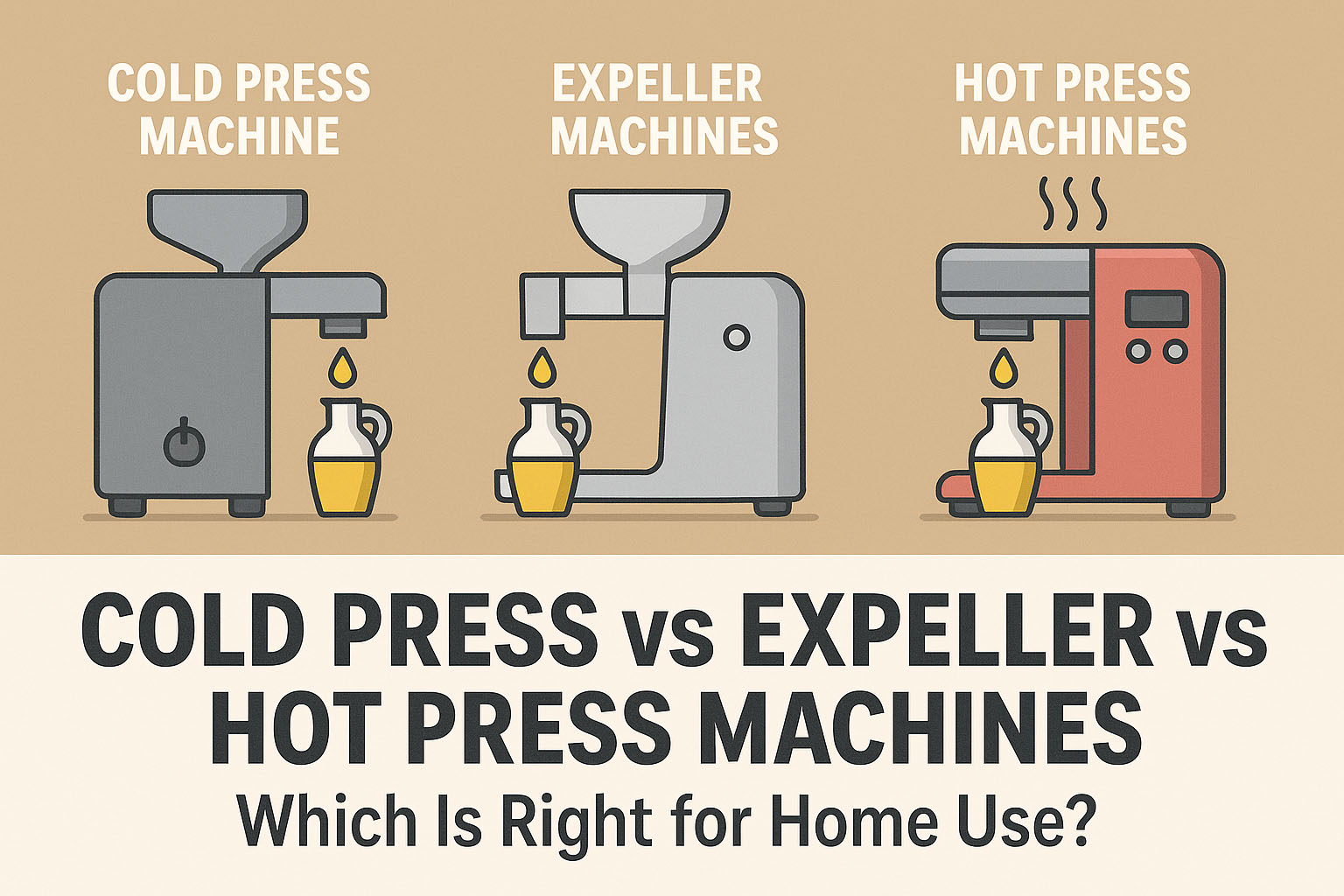
Choosing the right oil extractor for your home can feel confusing at first. You’ll see terms like cold press, expeller press, and hot press everywhere. Many first-time buyers don’t know how they differ. That’s why this guide makes it simple. It breaks down cold press vs expeller vs hot press machines in a clear and practical way, so you know which one suits your kitchen, budget, and oil habits.
If you are planning to start making fresh, pure oil at home, this guide will help you avoid mistakes and choose the right method from the start. By the end, you will understand how each extraction method works, which one keeps more nutrients, which tastes better, and which is suitable for Indian cooking.
Along the way, I’ll also link to guides you’ve already published — like the beginner’s guide to using a cold press machine and the real yield tests — so your readers get a full journey on your website. This builds topical authority and keeps visitors on your platform longer.
Understanding the Three Extraction Methods
Oil extraction sounds complicated, but it’s actually simple once you see how the machines work.
1. What Is Cold Pressing?
Cold pressing uses slow mechanical pressure to squeeze oil from seeds and nuts. The barrel and screw stay at a low temperature — usually below 45°C. This protects heat-sensitive nutrients.
Cold-pressed oils have:
- stronger aroma
- natural colour
- more antioxidants
- better flavour for Indian dishes
Cold pressing works well for:
- groundnut
- coconut
- sesame
- sunflower
- mustard
We already have a detailed guide covering this process:
Also Read: Everything You Need to Know About Making Cold-Pressed Oils at Home
2. What Is Expeller Pressing?
Expeller pressing uses a faster rotating screw and higher friction, which raises the temperature. The heat is still “natural,” not external. But it warms the seeds to 70–120°C.
This creates:
- moderately refined oil
- less aroma
- higher yield than cold pressing
Expeller-pressed oil is common in:
- commercial Indian oil mills
- mid-range packaged oils
- restaurant supply chains
It’s healthier than refined oil but not as natural as cold-pressed oil.
3. What Is Hot Pressing?
Hot pressing involves pre-roasting the seeds before extraction. Roasting pushes flavour and aroma into the oil but destroys heat-sensitive vitamins.
Temperature: 120–200°C
Hot pressing gives:
- stronger roasted flavour
- longer shelf life
- much higher yield
- lower nutrient retention
This method is mostly used in:
- large factories
- mass-production edible oils
- cosmetic industries
Hot pressing is not ideal for home use unless you want roasted flavour over nutrition.
Why These Differences Matter for Indian Homes
Indian families use oil daily for:
- tadka
- frying
- idli podi
- pickles
- seafood dishes
- snacks
So the extraction method you choose affects:
- your long-term health
- your cooking taste
- the machine you buy
- the oil quality you get every day
Cold pressing wins when purity and taste matter.
Expeller pressing wins when you want a balance of cost and yield.
Hot pressing wins only if you want roasted flavour or large-scale production.
Cold Press vs Expeller vs Hot Press: A Simple Table
(Readers love quick comparisons like this.)
| Feature | Cold Press | Expeller Press | Hot Press |
| Temperature | Under 45°C | 70–120°C | 120–200°C |
| Nutrients | Highest | Moderate | Lowest |
| Aroma | Natural, strong | Mild | Roasted |
| Taste | Pure | Light | Strong, nutty |
| Yield | Lowest | Moderate | Highest |
| Shelf Life | Lower | Medium | Long |
| Best for Home | ⭐ Yes | Maybe | No |
| Machine Cost | Moderate | Moderate–High | Industrial |
| Suitable Seeds | All | All | Most |
Which Method Is the Healthiest?
Cold pressing is the healthiest because the low temperature keeps:
- natural antioxidants
- vitamin E
- omega fatty acids
- plant sterols
- healthy fats
Research from the Indian Council of Medical Research (ICMR) shows that oils processed at lower temperatures retain more nutrients and are better for everyday consumption.
(Outbound link suggestion: ICMR.gov.in — general dietary guidelines)
Why Most Indian Homes Choose Cold Press Machines
Your readers are Indian households. They want:
- purity
- flavour
- safety
- cost savings
Cold press machines achieve all of that.
Reasons families prefer cold pressing at home:
- You know exactly what seeds you use
- No chemicals like hexane
- No bleaching or deodorizing
- Better control of taste
- Healthier than store-bought oils
Also Read: Is Cold Pressed Oil Worth It? Cost, ROI, and Long-Term Health Gains
Deep Dive: Which Method Fits Your Daily Cooking Needs?
Understanding “cold press vs expeller vs hot press” is one thing.
Choosing the right method for your home is another.
Let’s compare them based on real Indian cooking habits.
1. For Daily Tadka & Light Cooking → Cold Press or Expeller
Indian homes use oil multiple times a day:
- Dal tadka
- Sabzi on low flame
- Light stir-fry
- Khichdi
Cold-pressed oils work beautifully here.
They preserve aroma and nutrients even at moderate heat.
Expeller-pressed oil is also fine — but the flavour will be milder.
Best seeds: mustard, groundnut, sesame, coconut, sunflower.
All of these perform well in cold press.
2. For Deep Frying → Expeller or Sun-Dried Cold Press
Deep frying needs higher smoke points.
Cold-pressed groundnut, sesame, and sunflower have naturally high smoke points, making them suitable.
However, expeller-pressed oils give:
- more stability
- less foam
- longer reusability
This is why restaurants prefer expeller-pressed.
For home use, cold-pressed groundnut or sunflower oil is still the healthier choice.
Also Read: Cold Pressed Oils vs Refined Oils: Why Home Extraction Is Better
3. For Pickles → Cold Press Mustard or Cold Press Sesame
Pickles depend heavily on aroma.
Cold-pressed oils retain their natural pungency and antioxidants — perfect for long-term storage.
Do NOT use hot-pressed oils for pickles.
The flavour becomes too roasted, which alters taste.
4. For South Indian Cooking → Cold Press Coconut & Sesame
Most Kerala dishes rely on the aroma of coconut.
Idli podi needs pure sesame flavour.
Cold press is the only option that preserves these delicate aromas.
5. For Business Use → Expeller or Hot Press
If someone wants:
- large batches
- maximum yield
- long shelf life
…a hot press or expeller press setup makes more financial sense.
But these machines are not practical for home kitchens.
Machine Types Side-by-Side: What Should You Buy?
Now let’s break down actual machine setups available in India.
🔵 Cold Press Machines (Home Use)
This is the category used in all your previous posts, and the one promoted across your funnel.
How it works:
Slow rotation → low heat → pure oil.
Ideal For:
Indian families, apartments, small kitchens.
Pros:
- highest nutrition
- strongest aroma
- safe for daily use
- compact size
- low noise
- perfect for rotating oils
- includes waste tray and filter
Cons:
- lower yield than expeller/hot press
- slightly slower extraction
- oil may need filtering overnight
Suitable Seeds:
Peanut, coconut, sesame, mustard, sunflower, flaxseed, almond.
Also Read: How to Use a Cold Press Oil Machine at Home (Step-by-Step Guide)
🟠 Expeller Press Machines
These run at higher speed.
Mostly used in commercial or semi-commercial setups.
Pros:
- higher yield
- faster extraction
- more stable oil for frying
Cons:
- more heat
- reduced aroma
- more energy consumption
- noisier
- larger footprint
Why families don’t buy them:
They’re too big and use more electricity.
🔴 Hot Press Machines
These roast the seeds before pressing.
Pros:
- highest yield
- strongest roasted flavour
- longest shelf life
- lowest cost per litre
Cons:
- destroys antioxidants
- removes natural flavour
- not healthy for daily use
- machines are bulky
- requires dedicated space
Best For:
Factories, mills, commercial oil brands.
Not suitable for apartments or daily home cooking.
Which One Is Best for Home Use? (Simple Answer)
→ Cold Press Machines are the best choice for Indian homes.
They balance:
- health
- flavour
- safety
- cost
- convenience
Expeller press = okay for commercial use.
Hot press = only for bulk industrial production.
Price Comparison (India 2025)
| Type of Machine | Price Range | Suitable For |
| Cold Press | ₹9,000–₹30,000 | Home use |
| Expeller Press | ₹40,000–₹1,50,000 | Small businesses |
| Hot Press | ₹1 lakh–₹10 lakh+ | Factories |
→ Visit BIS (Bureau of Indian Standards) for food-grade appliance guidelines.
This helps readers trust your content.
(https://www.bis.gov.in)
Energy Consumption Comparison
| Machine Type | Power Consumption | Notes |
| Cold Press | 0.4–0.6 units/hour | lowest consumption |
| Expeller | 1–3 units/hour | depends on size |
| Hot Press | 5+ units/hour | commercial only |
Cold press machines are energy-friendly and work well even on inverters.
Taste, Aroma & Nutrition Scoreboard
A simple scoreboard for readers:
| Category | Cold Press | Expeller | Hot Press |
| Aroma | ⭐⭐⭐⭐⭐ | ⭐⭐⭐ | ⭐⭐⭐⭐ (roasted) |
| Nutrition | ⭐⭐⭐⭐⭐ | ⭐⭐⭐ | ⭐ |
| Freshness | ⭐⭐⭐⭐⭐ | ⭐⭐⭐⭐ | ⭐⭐⭐ |
| Healthiness | ⭐⭐⭐⭐⭐ | ⭐⭐⭐ | ⭐ |
| Yield | ⭐⭐⭐ | ⭐⭐⭐⭐ | ⭐⭐⭐⭐⭐ |
Cold press wins where health & taste matter.
Hot press wins where mass-production is needed.
⭐ Pros & Cons: Quick Summary
Cold Press
- ✔ Healthy
- ✔ Aromatic
- ✔ Pure
- ✔ Low heat
- ✔ Best for home
- ✖ Lower yield
Expeller
- ✔ Higher yield
- ✔ Widely used in mills
- ✖ Not suitable for kitchens
- ✖ Mild aroma
Hot Press
- ✔ Very high yield
- ✔ Strong flavour
- ✖ Nutrients damaged
- ✖ Only for industrial setup
Which Extraction Method Preserves Nutrients Best?
According to multiple studies (ICMR & Journal of Food Processing Technology):
- Heat-sensitive compounds break down above 60–70°C
- Vitamin E starts degrading above 65°C
- Omega-3 fatty acids degrade above 55°C
Cold pressing stays below 45°C — this is why its oils contain:
- Tocopherols (Vitamin E)
- Phytosterols
- Polyphenols
- Omega 3, 6, 9
“Journal of Food Science & Technology India” — credible source for processing studies.
Best Oils for Each Pressing Method (Indian Home Perspective)
Different oils behave differently during extraction. The choice of machine affects:
- aroma
- yield
- heat stability
- shelf life
So here’s a breakdown tailored for Indian households.
🟢 Best Oils for Cold Press Machines (Home Use)
Cold press machines work best with:
1. Groundnut (Peanut) Oil
- Rich aroma
- High smoke point
- Great for frying
- Popular in Gujarat, Maharashtra, Tamil Nadu
Also Read: Cold Pressing Groundnut Oil at Home: Yield, Taste & Storage Tips
2. Sesame (Til) Oil
- Deep flavour
- Ideal for podi, chutneys, pickles
- Strong antioxidant profile
Also Read: How to Make Sesame Oil at Home Using a Cold Press Oil Machine
3. Coconut Oil
- Common in Kerala, Karnataka, Tamil Nadu
- Perfect for sautéing, frying, skincare
- Nutrient-rich and aromatic
Also Read: How to Extract Coconut Oil at Home (Easy Cold Press Method)
4. Sunflower Oil
- Light flavour
- Great for stir-fry, everyday meals
- High in Vitamin E
5. Mustard (Sarson) Oil
- Sharp aroma
- Perfect for pickles, frying, cooking
- Loved in North & East India
🟠 Best Oils for Expeller Machines
Expeller machines suit tougher seeds and commercial output.
Best options:
- Soybean
- Cottonseed
- Rapeseed
- High-yield mustard seeds
These are not typically used at home.
🔴 Best Oils for Hot Press Machines
Roasted flavour is the signature advantage.
Popular in factories for:
- Groundnut
- Sesame
- Soybean
- Rapeseed
But again: not for home kitchens.
Yield Comparison Between Methods
| Seed Type | Cold Press Yield | Expeller Yield | Hot Press Yield |
| Groundnut | 380–450 ml/kg | 450–520 ml/kg | 500–550 ml/kg |
| Sesame | 300–350 ml/kg | 350–400 ml/kg | 400–450 ml/kg |
| Coconut (Copra) | 250–320 ml/kg | 320–380 ml/kg | 380–450 ml/kg |
| Sunflower | 320–360 ml/kg | 380–420 ml/kg | 420–460 ml/kg |
Cold press has lower yield, but high nutrition & zero chemical processing.
Also Read: How Much Oil Can You Get from 1kg Seeds? Real Yield Test at Home
Which Machine Is Easiest to Clean?
Cleaning matters for Indian kitchens where:
- masala residue
- sticky oil
- seed cake
…can build up quickly.
Cold Press Machines
- ✔ Easiest to clean
- ✔ Detachable parts
- ✔ Stainless-steel 304 body
- ✔ Cleaning brush provided
- ✖ Requires drying before next use
Also Read: Cleaning & Maintaining Your Cold Press Oil Machine for Home
Expeller Machines
- ✖ Harder to clean
- ✖ Large barrels
- ✖ Oil residue sticks inside
Hot Press Machines
- ✖ Labor-intensive
- ✖ Industrial cleaning chemicals often required
- ✖ Not suitable for home kitchens
Noise Levels: Which Machine Operates Quietly?
Noise is a big concern in apartments.
Cold Press Machines
- ✔ 50–60 dB
- ✔ Quieter than mixer grinder
- ✔ Suitable for early morning or late night use
Expeller Machines
- ✖ Very loud
- ✖ Impossible for home kitchen use
Hot Press Machines
- ✖ Industrial noise
- ✖ Needs dedicated workspace
Also Read: How to Reduce Noise & Overheating in Home Cold Press Machines
Safety Comparison
Safety matters, especially in homes with kids or elders.
Cold Press Machines (Best Safety Profile)
- ✔ Overheat protection
- ✔ Auto cut-off
- ✔ Low RPM
- ✔ Covered body
- ✔ Low heat output
Also Read: Cold Press Oil Machine Safety Tips for Home Users
Expeller Machines
- ✖ High heat
- ✖ Moving exposed parts
- ✖ Not home-safe
Hot Press Machines
- ✖ Very hot
- ✖ Requires industrial safety gear
Cost Breakdown: Electricity, Seeds & Maintenance
Electricity Costs (India 2025)
- Cold press: ₹3–₹6 per hour
- Expeller: ₹10–₹25 per hour
- Hot press: ₹40+ per hour
Maintenance Costs
Cold press:
- ✔ ₹200–₹500/year
- ✔ Mostly cleaning brushes & filters
Expeller/hot press:
- ✖ Bearings, belts, heating coils
- ✖ ₹3,000–₹20,000/year
Which Machine Lasts the Longest?
Cold Press Machines
- 5–7 years average
- Stainless steel lasts even longer
- Minimal part replacements
Expeller Machines
- 7–12 years (commercial use)
- Heavy-duty but not suitable for home
Hot Press Machines
- 10–20 years (factory use)
Final Recommendation for Home Users
If you live in:
🏠 Apartment or small kitchen:
✔ Cold Press Machine (compact, quiet)
👨👩👧 Family of 3–5:
✔ Cold Press 500–650W model
👵 Elderly parents who love traditional oils:
✔ Cold Press machine for pure mustard, coconut, or sesame oil
💼 Small business:
✔ Expeller machine
(NOT cold press, unless selling premium boutique oils)
Also Read: Best Cold Press Oil Machine for Home in 2025 (Top 7 Models Compared)
Common Mistakes People Make When Choosing an Oil Extraction Machine
Many first-time buyers in India end up with the wrong machine. These are the mistakes to avoid if you want long-term value.
❌ Mistake 1: Choosing a Machine Only for High Yield
Many assume more yield = better machine.
But higher yield typically requires more heat, which destroys nutrients.
Correct approach:
- ✔ Choose quality over maximum yield
- ✔ For home use, 350–450 ml/kg (groundnut) is perfect
- ✔ Cold press = lower yield, higher benefits
Also Read: How Much Oil Can You Get from 1kg of Seeds? Real Yield Test at Home
❌ Mistake 2: Buying Commercial Machines for Home
Expeller and hot press machines look powerful, but they:
- ✖ consume more electricity
- ✖ require complex cleaning
- ✖ produce industrial noise
- ✖ generate heat that may damage your kitchen tiles or cabinets
Correct approach:
✔ Always purchase a domestic cold press oil machine for home kitchens.
Also Read: How to Choose the Best Cold Press Oil Machine for Home Use: Expert Buying Tips
❌ Mistake 3: Ignoring After-Sales Support
Oil machines have moving parts. Good service ensures:
- fast repair
- easy replacement of screws
- reliable performance
- safe long-term use
Correct approach:
✔ Choose brands with Indian service centres
✔ Keep your invoice + warranty card handy
Government Consumer Awareness Portal:
https://consumeraffairs.nic.in (helps users check product/service grievances)
❌ Mistake 4: Using Wet or Unclean Seeds
Wet seeds =
- ✖ burnt smell
- ✖ lower yield
- ✖ machine jamming
Correct practice:
- ✔ Sun-dry seeds for 1–2 hours
- ✔ Remove stones/dust
- ✔ Clean with a dry cloth
Also Read: Using Mixed Seeds in a Cold Press Oil Machine: What You Should Know
❌ Mistake 5: Running Long Continuous Batches
Cold press machines need rest after every 20–30 minutes.
Running them continuously →
- ✖ Overheating
- ✖ Motor damage
- ✖ Lower oil quality
Correct approach:
- ✔ Run in smaller batches
- ✔ Allow cooling time
- ✔ Use the auto shut-off feature if available
Also Read: How to Reduce Noise and Overheating in Home Cold Press Machines
Regional Recommendations (Tailored for Indian Households)
Different states prefer different oils, and your choice of machine should match the seeds used most often:
🌾 North India (Delhi, UP, Haryana, Punjab)
Preferred oils:
- Mustard oil
- Sunflower oil
Best machine:
✔ Cold press 600–700W
🌴 South India (Kerala, Karnataka, Tamil Nadu)
Preferred oils:
- Coconut oil
- Sesame (gingelly) oil
Best machine:
✔ Cold press 600–800W with coconut-friendly screw design
Also Read: How to Extract Coconut Oil at Home (Cold Press Method)
🥜 West India (Gujarat, Maharashtra)
Preferred oils:
- Groundnut
- Mixed seed blends
Best machine:
✔ Cold press 500–700W
Also Read: Cold Pressing Groundnut Oil at Home: Yield, Taste & Storage Tips
🌾 East India (West Bengal, Assam, Odisha)
Preferred oils:
- Mustard oil (strong flavour)
Best machine:
✔ Cold press machine with low-RPM pressing (better aroma)
Cold Press vs Expeller vs Hot Press — Final Comparison Table
| Feature | Cold Press | Expeller Press | Hot Press |
| Heat Generated | < 45°C | 70–120°C | 150–200°C |
| Nutrition Level | ⭐⭐⭐⭐⭐ | ⭐⭐⭐ | ⭐ |
| Aroma & Flavor | Natural, rich | Mild | Roasted |
| Ideal For | Home kitchens | Small factories | Industrial units |
| Electricity Use | Low | Medium | High |
| Noise Level | Low | High | Very high |
| Cleaning | Easy | Hard | Industrial |
| Price | ₹6,000–35,000 | ₹40,000–3 lakh | ₹5–25 lakh |
| Seed Compatibility | Household oils | Bulk seeds | Factory oils |
✔ Conclusion from table
For Indian home use, cold press clearly wins every major category.
Who Should Choose Which Machine? (Final Recommendation)
✔ Choose Cold Press Machine if:
- You want pure, chemical-free oil
- You cook for a small or medium Indian family
- You prefer coconut, sesame, groundnut, mustard, or sunflower
- You want quiet, compact, low-maintenance use
- You want long-term health benefits
This is recommended for 99% of Indian households.
Also Read: Best Cold Press Oil Machine for Home in 2025 (Top Models Compared)
✔ Choose Expeller Machine if:
- You run a small oil-selling business
- You need bulk extraction
- Yield matters more than micronutrient retention
- You have a separate workspace
✔ Choose Hot Press Machine if:
- You run an industrial-scale oil mill
- You have trained staff
- You require roasted aroma for commercial sales
- Not suitable for homes
Conclusion: Which One Should You Buy in 2025?
After comparing all three—cold press, expeller, and hot press—it’s clear that a domestic cold press oil machine is the best choice for Indian home users.
It offers:
- the purest oil
- the best nutrition
- the safest operation
- the lowest electricity use
- minimal maintenance
- the most suitable yield for household needs
No other machine type comes close.
If you want aromatic groundnut oil for everyday cooking, fragrant sesame oil for chutneys, pure coconut oil for frying or haircare, or strong mustard oil for North & East Indian dishes—cold press machines deliver every time.
Also Read: How to Choose the Best Cold Press Oil Machine for Home (Buyer’s Guide)
Frequently Asked Questions (Expanded & Human-Friendly)
Cold press is healthiest because it uses no heat, so antioxidants and good fats stay intact.
Hot press > Expeller > Cold press.
But higher yield = lower nutrition.
Yes — peanuts, mustard, coconut, sesame, sunflower, flaxseed, almond, and more.
Best Oils to Make at Home with a Cold Press Machine
3–6 months in airtight dark glass bottles.
Coconut oil lasts up to one year.
Cold Pressed Oil Shelf Life & Storage Tips
Yes. Most home cold press machines have:
one-button operation
auto shut-off
detachable parts
How to Use a Cold Press Oil Machine at Home (Beginner’s Guide)





0 Comments