
Introduction
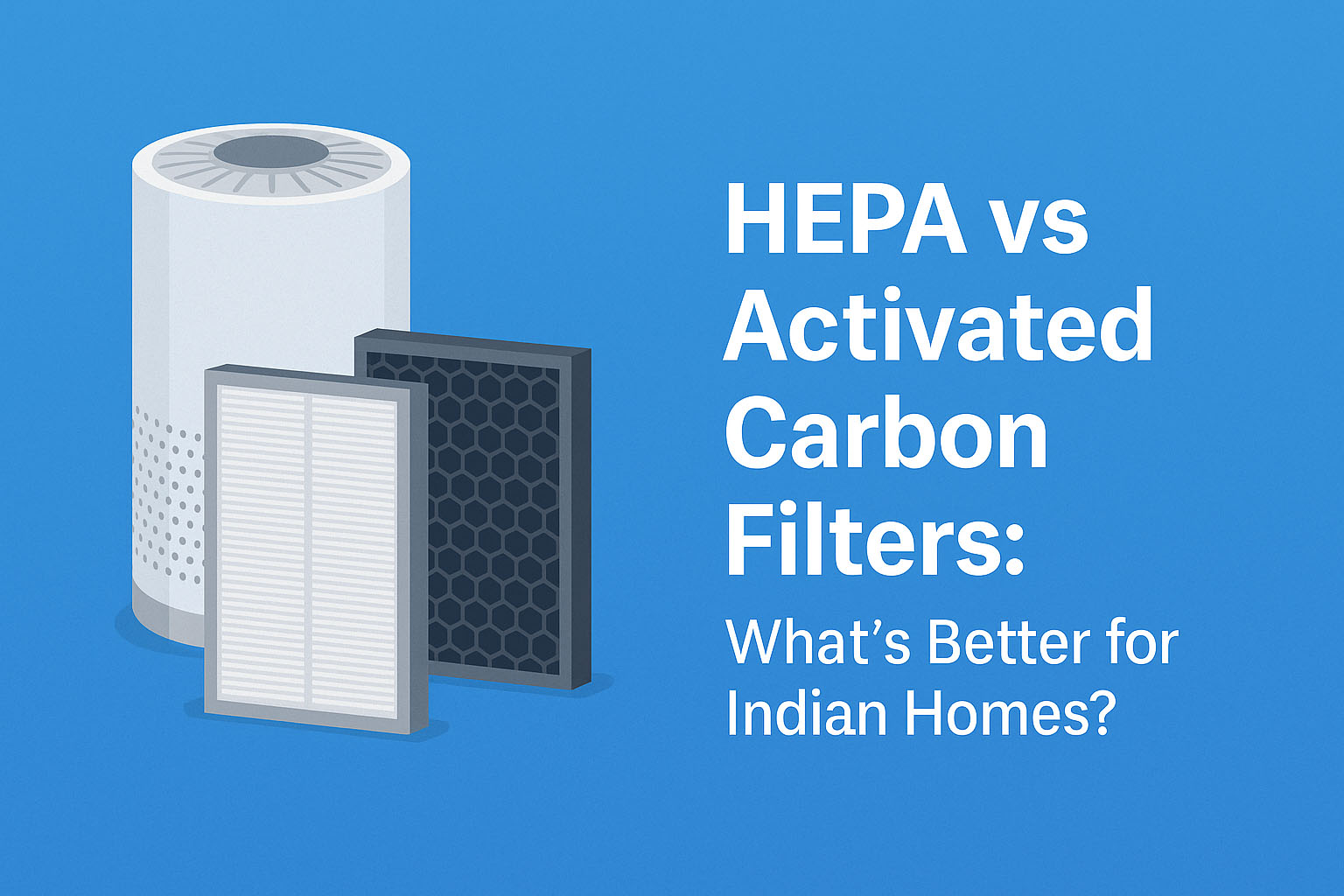
Choosing the right air purifier can be confusing, especially when you’re comparing HEPA vs Activated Carbon filters. Both filters serve different purposes, and most Indian homes need a combination of the two. Although many people assume that more filters mean better purification, the truth is that each filter targets a specific type of pollutant.
Understanding the difference between HEPA and Activated Carbon is the first step in choosing the right air purifier for your home. For example, if your primary concern is dust and PM2.5 pollution, a HEPA filter is essential. However, if you struggle with cooking smells, traffic fumes, or chemical odours, a carbon filter becomes equally important.
In India’s pollution-heavy environment, knowing which filter matters most—and why—helps you make a smarter buying decision. If you haven’t yet explored our detailed model breakdowns, you can later check our Best Air Purifier for Home in India (2025 Buyer’s Guide) to compare real performance.
What Is a HEPA Filter? (The Critical Dust & PM2.5 Filter)
A HEPA (High-Efficiency Particulate Air) filter removes solid microscopic particles floating in the air. This includes:
- PM2.5
- PM10
- Dust
- Pollen
- Mold spores
- Dust mites
- Pet dander
- Bacteria-sized aerosols
According to the WHO Air Quality Guidelines, PM2.5 levels are one of the biggest health risks in India. Because these particles enter the bloodstream, HEPA filters are essential in cities like Delhi, Noida, Mumbai, and Kolkata.
How HEPA Filters Work
HEPA uses a dense fibre mesh to trap particles using three scientific principles:
- Interception: Large particles stick to fibres.
- Impaction: Medium particles collide and get trapped.
- Diffusion: Ultra-small particles zig-zag into the fibres.
This multi-stage trapping mechanism is why HEPA is so effective.
HEPA Grades
- H11/H12: Medium filtration
- H13: Ideal for Indian homes
- H14: Medical-grade
Most good purifiers in India—like Coway, Philips, and Sharp—use H13 HEPA because it removes 99.97% of fine particles.
What Is an Activated Carbon Filter? (The Odour & Gas Filter)
While HEPA removes particles, the Activated Carbon filter removes gases, smells, fumes, and chemicals—pollution types that HEPA cannot trap.
Carbon filters absorb:
- Gas stove fumes
- Kitchen smoke
- Burning oil smell
- Cigarette smoke
- Traffic fumes
- VOCs (paint, cleaning chemicals, perfumes)
- Pet odours
- Food smell
- Mosquito coil smoke
These pollutants are common in Indian homes, where cooking involves strong spices, deep frying, and high heat. Even the CPCB (Central Pollution Control Board) highlights VOCs as a major indoor pollutant.
How Activated Carbon Filters Work
Activated carbon contains millions of tiny pores. These pores trap odor molecules and gases through adsorption, a chemical bonding process.
The thicker the carbon, the better the performance. That’s why premium purifiers like Coway AirMega 250 and Blueair 211+ use heavy carbon blocks.
HEPA vs Activated Carbon Filters: What’s the Difference?
Although both filters clean indoor air, their functions are completely different:
| Feature | HEPA Filter | Activated Carbon Filter |
| Removes PM2.5 & dust | ✔️ | ❌ |
| Removes smoke | ❌ | ✔️ |
| Removes smell | ❌ | ✔️ |
| Removes gases (VOCs) | ❌ | ✔️ |
| Removes pollen & allergens | ✔️ | ❌ |
| Removes bacteria-sized particles | ✔️ | ❌ |
| Ideal for kitchens | ❌ | ✔️ |
| Ideal for traffic smoke | ❌ | ✔️ |
HEPA = particles
Carbon = gases & odours
Most Indian homes need both.
Which Is Better for Indian Homes: HEPA or Activated Carbon?
For Indian conditions, the clear answer is:
Both filters are necessary.
They solve two different indoor pollution problems:
Use HEPA if you’re concerned about:
- PM2.5
- Dust
- Allergies
- Asthma
- Pollen
- Pet dander
- Dust mites
Use Activated Carbon if you’re concerned about:
- Cooking smells
- Gas stove fumes
- Mosquito coil smoke
- Cigarette smoke
- Traffic fumes
- Paint odours
- Chemicals
Most modern air purifiers combine both filters.
If you want a complete comparison, you can check our deep-dive post Which Is the Best Air Purifier in India? Honest Comparison (2025 Edition).
HEPA Filter Advantages
1. Best for PM2.5
India faces dangerous PM2.5 levels, especially in winter.
2. Best for Allergies
Great for people who suffer from dust allergies or asthma.
3. Completely Safe
No chemicals, no ozone, no side effects.
4. Long Filter Life
Typically lasts 10–18 months in Indian conditions.
HEPA Filter Limitations
Cannot remove cooking smells
It does not remove gases or VOCs
Cannot remove cigarette smoke
Filters need replacement (not washable)
Although HEPA filters handle particles perfectly, they cannot control odours.
Activated Carbon Advantages
1. Excellent for Indian-style cooking
Carbon absorbs oil fumes and tadka smell.
2. Great for gas stove emissions
Carbon traps NO₂ and CO traces.
3. Removes chemical fumes
Fresh paint, cleaning liquids, perfumes—carbon handles them all.
4. Removes cigarette smoke
HEPA cannot remove the harmful gases in cigarette smoke, but carbon can.
Activated Carbon Limitations
Does not remove PM2.5
Cannot trap dust or pollen
Ineffective against bacteria
Needs thicker carbon to work well
Low-quality purifiers use weak carbon sheets
This is why carbon must always be combined with HEPA.
Which Rooms Need HEPA vs Activated Carbon Filters?
Bedrooms
- HEPA is essential
- Carbon optional
- Recommended: Coway AirMega 150
Living Rooms
- HEPA + thick carbon
- Recommended: Philips AC2887/20
Kitchens (or areas near kitchen)
- Carbon is essential
- Recommended: Coway AirMega 250
Homes near traffic
- Carbon handles exhaust fumes
- Recommended: Blueair 211+
This room-based approach helps match the right filter to your environment.
Cost Comparison: HEPA vs Activated Carbon
| Filter Type | Average Replacement Cost | Life Span |
| HEPA | ₹2,000–₹4,500 | 10–18 months |
| Activated Carbon | ₹1,500–₹3,500 | 8–12 months |
HEPA is usually more expensive but lasts longer.
Which One Should You Choose?
If your primary question is HEPA vs Activated Carbon filters, the answer depends on your home:
i. For pollution-heavy cities → HEPA is mandatory
ii. For homes with cooking smells → Carbon is mandatory
iii. For best results → Choose a purifier with both
Premium comparison lists in our Best Air Purifier in India with Price, Pros & Cons (2025 Updated Guide) show which models include strong HEPA + Carbon combinations.
Conclusion
Choosing between HEPA vs Activated Carbon filters becomes simple once you understand what each one does. HEPA removes particles like dust and PM2.5, while Activated Carbon removes gases, smells, and chemical fumes. Because Indian homes battle both problems, the best solution is a purifier that includes both filters. This combination ensures cleaner, safer, and fresher indoor air for your family.
FAQ Section
1. Is HEPA better than Activated Carbon?
No. Both have different purposes. HEPA removes particles; carbon removes gases.
2. Can I use a purifier with only a HEPA filter?
Yes, but it won’t remove odours or fumes.
3. Are carbon filters safe?
Yes. They do not release chemicals and contain natural charcoal.
4. How often should I replace HEPA and carbon filters?
HEPA lasts 10–18 months; carbon lasts 8–12 months depending on use.





0 Comments