
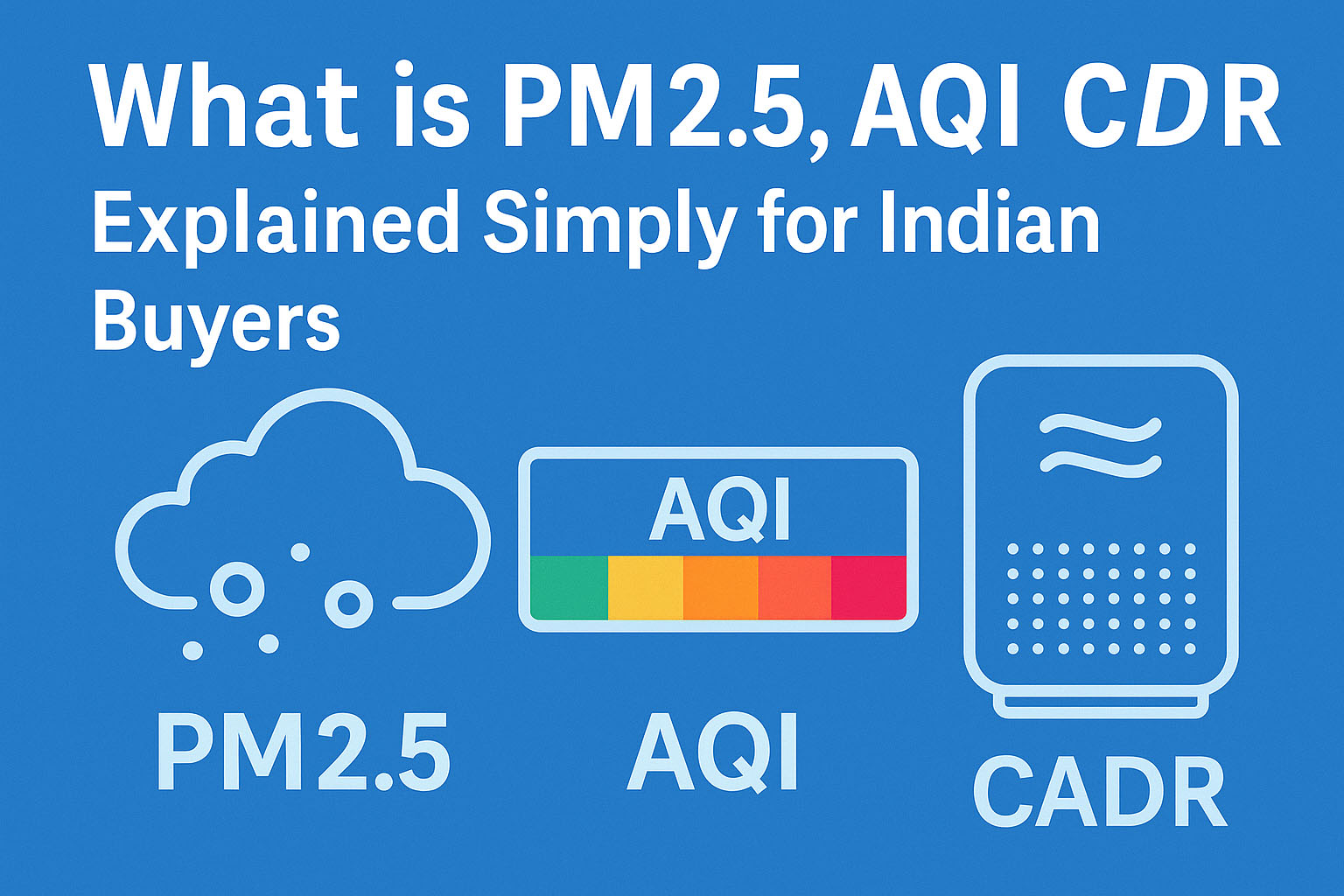
Introduction:
If you’re thinking about buying an air purifier, the first thing you’ll notice is how often terms like PM2.5, AQI, and CADR appear on product pages and reviews. Yet most people in India don’t know what these numbers actually mean. Understanding what is PM2.5 AQI and CADR helps you judge real purification performance instead of falling for marketing terms. It also helps you compare purifiers more accurately—something we covered in-depth in Which Is the Best Air Purifier in India? (2025 Comparison Guide).
When you know what these three terms represent, choosing the right purifier becomes simple, logical, and fully aligned with the pollution levels in your city. In this guide, we explain everything in plain words, with Indian household examples and practical tips.
What Is PM2.5? (Explained for Indian Homes)
PM2.5 refers to tiny airborne particles that are 2.5 microns or smaller. They are invisible to the naked eye and come from:
- Vehicle exhaust
- Construction dust
- Industrial smoke
- Burning garbage
- Cooking oil fumes
- Smog trapped during winter
- Firecrackers
- Dust on roads and open plots
Because these particles are extremely small, they enter deep into the lungs and even the bloodstream.
Why PM2.5 Is Dangerous in India
India has some of the highest PM2.5 levels in the world. The WHO Air Quality Guidelines state that long-term exposure increases risk of:
- Asthma
- Lung infections
- Heart disease
- Reduced lung function
- Chronic cough
- Throat and eye irritation
Even “clean-looking” homes in India often have PM2.5 levels above 80–150 µg/m³ indoors. The safe limit recommended by WHO is 5 µg/m³, and the Indian CPCB standard allows up to 40 µg/m³ for 24-hour exposure.
How to Reduce PM2.5 Indoors
- Keep windows closed during high AQI hours
- Use wet dusting instead of dry sweeping
- Run a HEPA air purifier
- Seal gaps in balconies
- Use kitchen chimneys during cooking
If you want to understand how HEPA removes PM2.5, our article How Air Purifiers Work: The Science Behind Cleaner Indoor Air explains the science in simple terms.
What Is AQI? (Air Quality Index Explained Simply)
AQI (Air Quality Index) measures how polluted the air around you is. It gives a single number that represents overall air quality.
AQI Scale Used in India (CPCB Standard)
| AQI Range | Air Quality | Meaning |
| 0–50 | Good | Healthy |
| 51–100 | Satisfactory | Acceptable |
| 101–200 | Moderate | Sensitive groups affected |
| 201–300 | Poor | Breathing discomfort |
| 301–400 | Very Poor | Respiratory issues |
| 401–500 | Severe | Serious health effects |
Indian metro cities frequently cross AQI 250–400 during winter, especially Delhi-NCR. Even cities like Mumbai, Kolkata, and Bengaluru see spikes above 150 during festivals, traffic peaks, and construction periods.
Why AQI Matters for Indian Buyers
When choosing a purifier, AQI helps you understand:
- How polluted your city actually is
- How strong your purifier needs to be
- When to keep windows closed
- When to increase purifier speed
Air purifiers with good sensors respond automatically when AQI rises indoors.
What Is CADR? (Clean Air Delivery Rate Explained)
CADR tells you how fast and how much clean air a purifier can produce in one hour. It is measured in m³/hr (cubic meters per hour).
In simple words:
Higher CADR = Faster and more effective cleaning.
Why CADR Is Important
CADR determines:
- Room size coverage
- Cleaning speed
- Air circulation rate
- Purifier efficiency in polluted cities
For example:
- CADR 200–250 → small rooms (100–150 sq ft)
- CADR 250–330 → medium rooms (150–250 sq ft)
- CADR 330–450+ → living rooms (250–500 sq ft)
You’ll find these ratings explained further in our pillar article Best Air Purifier for Home in India (2025 Buyer’s Guide).
Quick Summary Table: PM2.5, AQI, and CADR
| Term | Meaning | Why It Matters |
| PM2.5 | Fine particles from pollution | Most harmful to health |
| AQI | Overall air pollution score | Helps track air quality |
| CADR | Cleaning speed of purifier | Helps choose right purifier |
Together, these numbers tell you how polluted your air is and how powerful your purifier needs to be.
Why PM2.5, AQI, and CADR Matter for Indian Homes
India’s air pollution levels fluctuate through the year due to:
- Winter smog
- Post-Diwali smoke
- Construction dust
- Vehicle emissions
- Crop burning
- Coastal humidity trapping pollutants
Because of this, PM2.5 and VOCs build up quickly indoors. AQI spikes often push indoor pollution higher, and only a purifier with the right CADR can clean the room effectively.
Example: Delhi NCR Winter
- Outdoor AQI: 350+
- Indoor PM2.5: 200+
- A CADR 250 purifier will struggle
- A CADR 350+ purifier will clean efficiently
Example: Mumbai Monsoon
- Humidity increases mold spores
- Construction dust remains trapped indoors
- AQI fluctuates between 80–150
- A HEPA purifier helps maintain healthy levels indoors
This is why trusted brands like Coway, Philips, and Blueair focus heavily on CADR performance in their best-selling models.
How Air Purifiers Use These Metrics
HEPA Filters → Remove PM2.5 & PM10
They trap solid particles, allergens, dust mites, pollen, and smoke. If PM2.5 is your main concern, HEPA is mandatory.
Carbon Filters → Help When AQI Has Odours or VOCs
These absorb gases from cooking, cleaning liquids, paint, and traffic.
CADR → Determines Overall Performance
A purifier with high CADR will refresh indoor air faster and handle pollution spikes better.
For a full explanation of HEPA vs carbon systems, refer to our deep-dive post HEPA vs Activated Carbon Filters: What’s Better for Indian Homes?
How Much CADR Do You Need? (Simple Calculation)
To choose the right purifier, multiply your room size by 2 or 3, depending on pollution level.
Step-by-step:
- Measure room in sq ft
- Convert to sq meters (divide by 10)
- Multiply by 2
- Multiply by 3 (for polluted cities)
Example: 150 sq ft room
- 150 sq ft ≈ 15 sq m
- CADR needed: 15 × 2 = 300 m³/hr
This is why models like Philips AC2887/20 and Coway AirMega 150 are popular—they offer ideal CADR for Indian bedrooms.
How to Interpret AQI Indoors
A good purifier reduces indoor AQI significantly:
| Indoor AQI | Meaning |
| 0–30 | Excellent |
| 30–70 | Clean |
| 70–100 | Acceptable |
| 100–150 | Slight pollution |
| 150–250 | Polluted |
| 250+ | Highly polluted |
Many premium purifiers display real-time indoor AQI through LEDs or screens. For example, the Philips 3000i shows exact PM2.5 levels digitally.
Why Indian Buyers Should Understand CADR Before Purchasing
Most Indian homes have:
- Open kitchens
- Small bedrooms
- Medium living rooms
- Poor ventilation
- Traffic exposure
- High dust levels
CADR ensures the purifier can handle these realities. Without enough CADR, a purifier may clean too slowly or only partially.
Conclusion: Now You Know What PM2.5, AQI, and CADR Mean
Understanding what is PM2.5 AQI and CADR gives you complete clarity on how air quality works in Indian conditions and how to choose the right purifier. PM2.5 affects your lungs, AQI shows the overall pollution level, and CADR tells you how fast your purifier can clean the air. Together, these three numbers determine indoor air safety for your family.
When you use this knowledge, choosing a purifier becomes simple, factual, and effective.
FAQ
Very small pollution particles from dust, smoke, and vehicles
A number that shows how polluted the air is.
How fast an air purifier can clean your room.





0 Comments